Monday, August 15, 2005

Truth in Advertising: NYC Gets Jobbed

In an ad that is not only misleading, as today’s NY Sun editorial incisively points out, but is also factually incorrect, as Steve Malanga as already exposed, Mayor Bloomberg continues to tout his five borough economic development plan. If the so-called plan was a product it would have to be recalled as defective. As an advertisement, it should be subject to sanction under any truth in advertising statute.

We’ve already pointed out just how outrageous the mayor’s small business claims are but the Sun editorial really hits the mark by exposing, in comparison to smaller cities like Seattle who were also hard hit by 9/11, just how miniscule NY’s job gains are. In addition, it its most telling observation Seth Lipsky (no relation) and company rightly point out that the job growth in NYC has little to do with any actions of the municipal government.

In fact, an opposite conclusion could easily be drawn. The Sun, after citing Governor Arnold Schwarzenegger’s point about businesses creating jobs, not politicians, states:

Businesses create jobs best when they're in cities and states that keep costs low through lower taxes, lower spending, and less regulation
This is exactly what the mayor has failed to do. He has passed record tax increases and, in a shameful example of disinformation, tries to peddle piddling rebates as tax relief. We would have expected a businessman to have a better handle on this but Bloomberg’s own business, somewhat like a Saudi Arabian oil well, seems immune to the standard rules that govern productivity.

In fact, the mayor, although a businessman himself, seems totally out of touch with those “lesser entities” who are forced to struggle when the business climate is inhospitable. That’s why the mayor, when he was asked about the impact of the so-called bodega tax – the 1800% cigarette tax increase from .08 cents to $1.50 a pack said that it was a “minor economic matter.”

Matt Lipsky Goes On Vacation

The indefatigable Matt Lipsky is taking a few days off so he's leaving the technical aspects of this blog in less capable hands. We wish him well and await his speedy return.

Sunday, August 14, 2005

A Picture's Worth

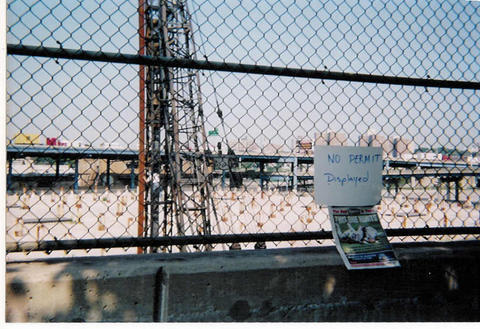
It seems that Related, thinking its Gateway Mall redevelopment plan is a done deal, has begun initial construction on the site. Not only is this a purposeful attempt to disrupt the market's business but it's also patently illegal for Related to begin any sort of building prior to city approvals. We're going to look into this further but in the mean time take a look at these telling pictures:


And here are some pictures of the market when it rains. Apparent is both Buntzman and the city's negligence in maintaining the market and the lunancy inherent in the fact that the merchants are currently paying over 10 times what Related is paying in rent.


Friday, August 12, 2005

Bronx Community Board 4 Piqued

As part of the ULURP process, Bronx Community Board 4 is charged with reviewing both the Terminal Market redevelopment as well as the plans for a new Yankee Stadium.
After attending an emergency session of the board’s Land Use/Housing committee we learned one thing: they are very, very upset.

Their first major concern is the way that the development process is moving forward. Committee chairwoman Mary Blassingame bluntly remarked that the Related Companies and the City were purposely circumventing the community by certifying the Gateway project certified in July. As a wan representative from the Department of City planning looked on, Ms. Blassingame and a number of people present pointed out the inherent injustice in trying to review in only a few weeks a project whose EIS is hundreds of pages long. Each respondent remarked that this time frame wasn’t an accident but the City's and the Related Companies’ way of skirting public review. A similar sentiment was echoed with the Yankee Stadium proposal due to the fact that the scoping hearing was so poorly advertised that even local elected officials and community board members did not even know it was taking place.

The lack of a true public process was not the only concern expressed at the meeting. Board members and community residents also had a number of specific issues with each project. There was a tremendous worry about the traffic impact of these two projects especially because each encouraged a drastic increase in the number of cars coming into the neighborhood. Considering that the South Bronx is known as “Asthma Alley” community members questioned the affect of this increased congestion on already dangerous air quality levels. With both Gateway and Yankee Stadium, people also questioned the developers’ traffic data and called for an independent review that reflected more than a corporation's self interest.

Other issues of concern were the loss of park land to the Yankee stadium project, the displacement of small businesses at the Terminal Market and around the stadium as well as the possibility that residents will be displaced either directly or indirectly through increased rents. All of these concerns have gone unanswered by the developers and for this reason it looks likely that the committee will vote down the Gateway project (which is up for review first) at their full meeting in September.

Councilman Oddo says no to Wal-Mart

In an interesting juxtaposition to Sager’s piece this morning the Crain’s Insider is reporting that Councilman James Oddo of Staten Island is poised to jump on the anti-Wal-Mart bandwagon. The impetus behind his move: Wal-Mart’s corporate welfare. As the Councilman says:

It’s the notion that I as a tax payer am underwriting part of the salary for Wal-Mart employees because they pay them a minimum salary but sign them up for every social program under the sun


As Anne Michaud of Crain’s points out, Oddo’s opposition to Wal-Mart, even though the two S.I. sites are outside his district, could seriously damage the chain’s chances there. Given the labor issues, the lack of unanimous political support on the Island will make it difficult for Wal-Mart to prevail at the City Council.

Cheap shot Wal-Mart

In a cheap shot at local area supermarkets Ryan Sager weighs in this morning about how the anti-Wal-Mart crowd is supposedly working to stop New Yorkers from getting low-priced groceries from a Wal-Mart supercenter. Once again, we find one of the retail giant’s supporters glossing over some facts about the predator that all city shoppers should be aware of.

In the first place Sager continues to remain in the dark about the importance of the ecology of this city’s neighborhoods. While he remains uninformed, however, New York’s neighborhood leaders are keenly aware of the “high cost of low prices.” This awareness was first brought home when the Alliance was successfully fighting to prevent a Pathmark shopping center from locating on Ditmars boulevard in Astoria. While we were working with the Astoria Heights Homeowners and Tenants Association and the United Concerned Citizens organization, the developer of the shopping center was putting full page ads in the local paper accusing Richard Lipsky personally of trying to block Astoria residents from having access to lower prices.

On a hot July evening, ten years ago, over 500 community members came out to denounce the shopping center. The community’s concern was that the project would erode the neighborhood’s quality of life by greatly increasing local traffic, encouraging transiency and crime and reduce the viability of the area’s local shopping centers.

Ryan, it’s the location

That shopping center was never build and it’s important to point out that the fight was never really about Pathmark (a company that Sager unfairly characterizes, along with Key Food and D’Agostino, as “flabby”). It was all about the inappropriateness of the size of that project in the location chosen by the developer.

We’ve made the same point about some of the propaganda coming from Wal-Mart’s pollsters. While the labor practices of the company and its retrograde social policies will always be a galvanizing issue, it will inevitably come down to a site fight when the company looks to build in this city.

Our guess is that large majorities of Staten Islanders who leave on the South Shore would, when polled, express generalized support for Wal-Mart. That generalized sentiment, however, will not translate into the same levels of support for a store there in Richmond Valley.

Labor Costs and the Price of Groceries

One other important point raised by Sager is that the correlation between labor costs and the prices of groceries. He raises a valid issue here, one that deserves the most open discussion. 60% of a supermarket’s overhead is in its labor costs so it stands to reason that if you can dramatically reduce these costs you can concomitantly lower the price of cheerios. There must be total transparency on this point. The lowering of labor costs means that workers will be paid less, and have fewer benefits at the same time they are losing the job protection and security that their union provides. In addition, and Sager should be extremely sensitive to this point, the fact that Wal-Mart is the leading promoter of corporate welfare in this country, forcing hundreds of thousands of its poorly compensated workers to access public health care benefits, means that lower grocery prices are being matched by higher health care costs and taxes for all New Yorkers.

Competition and Neighborhood Economies

Sager’s cheap shot at “flabby” local stores conceals that his notion of flab is the meat and potatoes that provide over 50,000 NYC supermarket workers with the ability to actually support a family. Even beyond this, however, is the fact that one of the flabby stores he singles out for opprobrium is Key Food, which isn’t a chain at all but a 200+ store co-op whose units are owned and run mainly by single proprietors.

These Key Food stores and the other independent supermarkets that are predominately minority-owned are the linchpin of neighborhood economies that have been resurrected by these risk-taking entrepreneurs from the devastation that affected this city thirty years ago. It is the successful revival of neighborhoods that has been a major variable in the dramatic reduction of crime in New York. People on the streets and neighbors shopping with neighbors is not some nostalgic vision but the actual description of vibrant commercial shopping areas. These strips bring more value to this city than the cheap sweatshop-produced goods that Wal-Mart imports.

Thursday, August 11, 2005

BJ’s at the Bronx Terminal Market

It has come to our attention that the Related Companies have a signed lease with BJ’s on the Bronx Terminal Market site. This, if true, contradicts everything that all the elected officials we’ve talked to have said. It is time for the truth to be told. It appears to us, however, that the community is being ignored, the elected officials are not being honestly informed, and the whole process, begun secretly and in a biased fashion, is continuing to stink up the Bronx.

Willets Point Jets

The News and Post are both reporting that Queens Borough President Helen Marshall is entreating the Jets to build a new stadium at Willets Point. In a letter to Jets President Jay Cross Marshall wrote:

A new stadium in America's most diverse borough would allow a New York team to return to where Joe Namath led it to victory in Super Bowl III. A new Jets Stadium would complement the new Shea Stadium and the spectacular U.S. Tennis Center and make the borough a regional sports mecca
Apparently Helen has scheduled a meeting with Cross on August 23rd to “discuss specific options” but the prevelant theory is that the Willets Point site, inconveniently occupied at this time, will be the target. We are particularly amused by the favorite depiction of the area as “long neglected.” Only in politics would the victims of neglect be singled out for obloquy and the developer’s bulldozer.

Here our suggestion: Why doesn’t the BP find a slightly run down area of Jamaica where the houses are not necessarily of the highest quality and do what the city of New London did? Imagine the rightful outcry here. So why is the displacement of small businesses who have been operating in an area for years no less objectionable?

Wal-Mart Spares no Expense

Wal-Mart Execs, acting as if they are running an exploratory political campaign, continued in their meetings with reporters and editors around the city. Yesterday the Daily News printed its third article in yet another of its neighborhood sections. Each of the articles, however, was lacking in any real news content and merely reiterated the same theme: Wal-Mart is looking at sites all over the city.

In the News pieces Wal-Mart also claims not to have any signed deals and that they are being unfairly maligned. Yada yada yada. The only new news: according to spokesperson Mia Masten:

We are amenable to either redeveloping or building from the ground up
Watch For the Booty Capitalists

Our own point-of-view is that Wal-Mart’s best opportunity is to find a site in and around a low-income community of color and, once designated, hook up with a community group and, a la Ratner, incentivize the relationship with a lucrative community benefits agreement.

The ultimate model for this was the East Harlem Pathmark deal that allowed the supermarket to enter the neighborhood over the opposition of local, mostly Hispanic, supermarket owners. The key ingredient here was the utilization of the Abyssinian Development Corporation as the project’s developer. In one stroke Pathmark’s potentially carpetbagger status was converted into a home court advantage because of its partnership with a local African-American powerhouse entity.

The one difference, of course, was the fact that Pathmark is a solidly unionized employer and had the backing of the labor forces. In spite of that, the Alliance came within one vote on the Manhattan Borough Board of denying the developer the land to build on. That one vote belonged to one of this city’s most noxious quislings: Guillermo Linares. Good old Guillermo, unable to get elected dog catcher anymore, has actually been resurrected by Mike Bloomberg, getting appointed as the Commissioner of Immigrant Affairs. The then-councilman thought that by supporting Pathmark he would become the heir apparent to Charley Rangel’s congressional seat. Guillermo, do you still believe what Charley and Ruth told you?

Wednesday, August 10, 2005

The Fast is Over: Gateway and the End of the Bronx Famine

Unbeknownst to most of us there are tens of thousands of Bronx residents who have gone without food for, God knows how long. We are only aware of this because of the shocking information that has been provided by the consultants for the Gateway Mall.

What gives us such a jolt is the fact that the building of a warehouse club at the Gateway site (either a BJ’s, Costco or Sam’s Club according to the EIS), a store that will be 4 or 5 times the size of any food store in the Bronx and will generate around $1.4 million a week in food sales, will have absolutely no significant impact on any other supermarkets within a 3 mile radius of the site.

The only way this is remotely possible is if there are tens of thousands of Bronx residents who, having fasted for years, are now going to decide, thanks to the beneficence of the Related Companies and their mall, to finally eat. These famished citizens are obviously the folks who are going to feed their hunger by storming the BJ’s or Sam’s Club, and buy $60 million a year worth of food. Knowing this, all the other food retailers in the Bronx and Northern Manhattan can relax.

Obviously this is all nonsense. The club store will have a major impact on local stores and the project’s consultants are being paid hundreds of thousands of dollars to obfuscate this undeniable fact.

Analyze Tax Benefits

We suggest everyone hark back to our discussion of accountable development. This Gateway project needs to be fully analyzed by independent evaluators who, not only know what they’re doing, but are concerned from an economic development point of view with an actual cost benefit analysis. This due diligence would include what the job gain and job loss will be, the quality of those jobs added and the return the city is getting for the tax breaks and low rent generously given to Related.

New York Magazine Jumps on Wal-Mart Bandwagaon

By now you might have seen the New York Magazine piece by John Heilemann on Wal-Mart’s plans for a New York City invasion. The article's paucity of substantive analysis on the broad-based nature of the opposition to the retail giant leaves it readers with little more than a lightweight culture criticism. It seems, in an ironic twist to be sure, that the magazine, home to the country’s richest readership and filled with nauseating paeans to the noveau riche, claims Wal-Mart’s critics are elitist snobs. You really have achieved something when you’re called elitist by New York Magazine.

Another tack taken by the author is that our Alliance belongs to a consortium of “nostalgists” because of our support for neighborhood retailers, as seen in our conservative case against Wal-Mart. To prove his point, this staunch proletarian ventured out of his Manhattan bunker and made a site visit to Rego Park where, on Queens Boulevard he found – don’t be shocked – chain stores!

This discovery apparently precipitated some kind of thought process that ended up by concluding that neighborhood retailing was dead, hence the nostalgist label. Ironically, the Manhattan voyager’s observations underscore his own West Side provincialism. Unaware no doubt that there are 186,000 mom-and-pop stores in hundreds of retail shopping strips Heilemann can only conclude that the neighborhood store is dead. Visitors to the Soviet Potampkin Villages in the 1930s had better insights than this.

What is definitely not surprising is the failure of the article to discuss the 1,000 predominately minority owned supermarkets that have risen in the last 30 years precisely when the national chains fled New York City. It is these stores that are providing quality food at reasonable prices (unlike the West Side) to neighborhoods that, until these independents came in, were simply abandoned. Now that’s a story to tell but don’t expect to see New York Magazine take any great interest.

Why Not Talk to Us?

What’s up with not even talking to us? If you’re going to do a piece that’s critical of the Alliance’s point of view why not contact us and get our reaction. Instead, having already developed its limited thesis, the article simply pulled a quote off of our website and proceeded to diminish its perspective without bothering to get a response. This kind of sloppy approach makes the final product what it is, a mélange of cutesy observations that lack substance and depth. In fact, the similarity between the article and the quality of Wal-Mart merchandise becomes more apparent with each paragraph you read.

Tuesday, August 09, 2005

Terminal Diagnosis

We’ve been taking a look at the EIS that was submitted on behalf of the Related Companies for its Gateway Mall at the Bronx Terminal Market. Just a cursory analysis of its purported socioeconomic impact section gives us a very good idea just why they are trying to bum rush the ULURP process. To put it kindly, the analysis is unadulterated crap and, if the traffic study is in any way like this section then God help the South Bronx.

Let’s take a peak:

1) According to the EIS, small neighborhood food stores won’t be impacted because these stores are “patronized by neighborhood residents who value the convenience … the high quality of goods and personal service…” (3-78).

This is nothing more than conventional wisdom and should be treated as a testable hypothesis, something which isn’t even considered by the consultants. In addition, while the assertion may be partially true it doesn’t necessarily follow that it is true in its entirety. What this means is that a large club store or supermarket may have impacts and those impacts need to be analyzed, a process that the EIS doesn’t feel is necessary.

It is also important to point out that many of the smaller specialty stores depend on the synergy created by the independent supermarkets who anchor local commercial strips. This brings us to the next assertion:

2) Larger supermarkets needn’t worry even though these stores “are likely to experience competitive pressure from a wholesale club or large chain supermarket…” There are a number of alleged reasons for this:

a. Sales will be diverted from other club stores in the areas surrounding the Bronx: “Therefore, some portion of sales at the Proposed Project’s wholesale club would represent sales that have been diverted from other wholesale clubs, not from local supermarkets” (3-80).

b. Local grocery stores are more convenient because the selection of goods would be greater and more varied than at a warehouse club: “Shoppers who prefer to have a wide assortment of items to choose from will continue to shop at area supermarkets” (3-82).

c. Local supermarkets are not critical to neighborhood shopping strips. In apparent response to the Alliance’s advocacy on this issue the consultants make two points:

i. Local supermarkets will not lose business from the food store(s) in the project

ii. Even if they do they’re not essential to neighborhood character

Consultants Provide no Empirical Data

In response to this section of the EIS we need to emphasize a number of points. First of all, the consultants simply make a number of untested statements without providing hard date as evidence. For instance, they do not survey store owners or their customers. They also fail to interview wholesale suppliers to determine whether certain stores within the trade area may be more vulnerable to the pressure of competition.

In addition, at no time do the consultants highlight the aggregate potential sales volume of its club store. For instance, our estimates in our analysis of the Brush Avenue BJ’s that went down to defeat this year predicted, based on industry estimates, that the store would do $60 million a year in food sales. In an attempt to finesse this issue, using neighborhood character, the consultants try to show that the larger stores are not generally anchors to local shopping strips.

To the extent to which this is true, however, this merely points out the weakness of the CEQR and the need to widen the scope of economic impact analysis that we’ve highlighted in our discussion of accountable development. How much of the $60 million will come from these unionized supermarkets? What will be the overall industry and employment impacts of the replacement of these unionized workers with a largely uninsured, non-union workforce. What will be the impact on the taxpayer when these workers must come to rely on the public health care system?

There’s Enough Business for those Stores

The other unsupported argument advanced in this section is that the areas where those other markets are located have enough local demand to withstand the competitive pressures of a box store at Gateway.

Once again we refer back to the original argument in this section that smaller local markets, appealing to neighborhood needs, will not be negatively impacted. Have the consultants looked the impact that larger supermarkets have had in other shopping center projects around the city? Are they aware that, in some cases, as many as five stores have closed when a regional chain store has opened?

The consultants also adopt a breezy, cavalier attitude towards the potential of indirect displacement. At not time do they bother to even speculate on a worst case scenario and the absence of any larger economic impact analysis that focused on the quality of the employment transfer leaves us with little confidence that an honest evaluation has even taken place. The big unanswered question is where will the $60 million in sales come from?

Traffic Issue Irony

One of the major defenses of Gateway on the traffic issue, made by Council member Arroyo, is that car and truck traffic will be less intrusive because the Gateway Mall is located near public transportation. Well, if that’s true someone should have told the consultants since a main argument they make is that local stores won’t be hurt too drastically “because the project site is not immediately proximate to public transit and that approximately 76% of household members in the 3 mile trade area do not have a vehicle available to them…” (3-80).

If this is true than then Gateway Mall will be attracting the bulk of its customers from outside the local neighborhoods and whatever the shopping values that will exist at the will not be easily available to local residents who will, nevertheless, have to accommodate the intense increase of vehicle and truck traffic through their already overburdened streets.

Our feeling is mixed on this. We believe that enough business will leak out from the neighborhood, especially the bulk weekend business that is so vital to neighborhood supermarkets to lead to the closing of a number of local stores. At the same time, and especially when we consider the food stamp and membership policies of BJ’s and Costco, we believe that the Gateway Mall will primarily exist as a destination for thousands of out-of-the-neighborhood shoppers so that, for the local community, the costs will greatly outweigh the benefits.

Monday, August 08, 2005

Gelinas Hits the Mark

Offering her usual sharp commentary in a sea of political polenta, Nicole Gelinas goes after the “temporary” nature of taxes under Lord Bloomberg. Her wrath is focused on the city’s personal income tax, something which most cities sensibly eschew.

Gelinas underscores the fact that this tax has the effect of retarding the city’s economic growth, something that Steve Malanga has already pointed out twice (the second time in a sharp rebuttal to Andrew Alper’s lame defense of the administration’s economic policy). Gelinas, picking up on the theme of her colleague at the Manhattan Institute, points out how this particular tax slows job growth:

More money for taxes means less money for investment — and fewer jobs for less affluent New Yorkers.
Spending: The Sacred Cow

Gelinas also underscores the reality of the city’s slow economic growth – in 2004 the national economy grew twice as fast as the overtaxed city’s. In doing so, she highlights the failure of the mayor along with the entire political elite, to do anything to keep down the the city’s spending.

The mayor in particular seems totally incapable of grasping this concept. Instead, extrapolating from his own business model, he sees New Yorkers as customers who need to be satisfied. As a result, his business model, melded to a liberal world view of benevolent government, has made it impossible for him to conceive of a government doing more by doing less; i.e. by allowing people and businesses to keep more of their money and invest it according to their own needs.

Which brings us back to our rant on non-partisan elections. The partisan primary system pushes candidates into pro-tax positions, often those that cater to the municipal unions that are so active and influential in Democratic primaries. A non-partisan election structure would at least create the opportunity for a more moderate, less tax-happy election process.

Non Partisan Elections

In 2003 Mayor Bloomberg launched his ill-fated (and it appears today to be politically unnecessary) effort to give NYC nonpartisan elections. We had mixed feelings at the time, primarily because it was so self-serving in its genesis. In addition, we also were working against Question 5, part of the charter referendum, that would have given the Department of Consumer Affairs judge and jury status over local stores.

Today, however, we’re not so sure where we stand. The reason for the musing comes from news of the official launching of Anthony Weiner’s mayoral campaign. We’ve definitely been impressed with his stands on taxes and small business but he has had trouble gaining traction among Democratic primary voters.

Weiner’s launch was keynoted by a pledge to lower taxes. In essence, he is taking a position to the right of the mayor in his appeal to roll back real estate taxes that are really hurting homeowners and neighborhood businesses. Yet we’re not sure that this issue, a galvanizing one we believe in a general election, will resonate for Weiner in the primary.

Which brings us to nonpartisan elections. The nature of the Democratic primary forces candidates to generally take the most liberal position on the issues. What is also does, however, is to open the door for moderate Democrats/Republicans like Bloomberg to win mayoral elections by appealing to moderate and conservative voters.

In four years, this may all be irrelevant since both Adolfo Carrion and Bill Thompson do have the ability to appeal to moderate voters. But, then again, no one saw Bloomberg coming in 2001 and it’s not inconceivable for another faux Republican billionaire to come along and borrow the mayor’s playbook.

All of which would be obviated by nonpartisan elections which would, by forcing candidates to appeal to a broader constituency, moderate their appeal and give democrats like Weiner a much better chance to win. This would be good for the Alliance’s neighborhood concerns.

Eminent Domain Animation

Check out this very good animated cartoon about eminent domain (hat tip: Big Cities, Big Boxes):


Eminent Domination: The Future Looks Bright

Taxing Mania

Why is it that every bold new election year initiative must be accompanied by a whopping tax increase? Today in the NY Sun the paper editorializes against Freddy Ferrer’s affordable housing plan with its concomitant billion dollar plus price tag. While we agree with the editorial’s point of view we’re more inclined to the plague on all your houses perspective outlined by Michael Goodwin in yesterday’s Daily News.

As Goodwin trenchantly points out, the middle class, now more black and brown than ever before, is being squeezed by the nation’s top tax burden. Our favorite quote: “New York takes a bite out of everything of value.” To his credit, Goodwin also goes after the fees and regulations that sometimes fly below the radar when people examine the city’s unconscionable taxing policy.

The mantra of the tax and spend crowd is always “tax the rich” and the appealing symbolism of the slogan always gives way to the less appealing reality, as Goodwin points out:

But the dirty little secret is that taxes and fees get passed through to the customer, most of whom belong to the broad middle class.
This burden is especially onerous to the city’s important small business sector. Already whacked by Bloomberg’s commercial real estate tax, these struggling store owners must fend off a daily barrage from inspectors whose ostensible job is to enforce city codes but whose real mission is tribute to a bloated municipal treasury.

What’s even worse is that after doing everything it can to make neighborhood stores uncompetitive, the Bloomdogglers then adopt a blame the victim economic development policy that seeks to help consumers get lower prices by building megastores that further victimize local stores.

Sunday, August 07, 2005

Taking Eminent Domain to the Max

Rich Lowry’s Saturday column in the New York Post (no link) underscores our running commentary about the protean nature of the anti-eminent domain coalition. Lowry features the always colorful and controversial Maxine Waters whose immediate and visceral reaction to the Kelo decision took some folks by surprise.

It shouldn’t have. A number of years ago Congresswoman Waters led a neighborhood opposition to the attempt by the LA Unified School District to take a park and a number of private homes in the community of South Park to build a school (Which actually is a legitimate use of the taking clause).

What is truly encouraging, however, is Waters’s unequivocal stance in favor of property rights, something that the liberal folks at the New Republic and the New York Times should learn from. Her strong stance is particularly important because it underscores what Justice O’Conner and Thomas have written about the vulnerability of poor communities of color to unrestricted government taking.

Saturday, August 06, 2005

Alper to the Defense

In a response to Steve Malanga’s NY Sun article that we’ve already commented on, EDC president Andrew Alper takes issue with the assertion that NYC’s economy has been stalled under the Bloomberg administration. He calls the Malanga article “completely off the mark” and “egregiously wrong.”

In the Mayor’s defense Alper claims that the City’s job growth is outpacing the national average with the outerboroughs contributing “more than 60% of the City’s job growth last year. Alper concludes by claiming that the mayor’s “five borough economic development strategy is working.”

Malanga’s response is to point out that Alper’s claim that all five boroughs experiences “significant job growth” is “patently absurd” since in total, the City’s job rolls grew by less than .03% last year, a gain of only 10,000 jobs (out of 3,541,700 jobs in total). On the contrary, according to Malanga, the national rate of job growth is triple NYC’s and to claim that the outerboroughs are contributing 60% of the City’s job growth demonstrates very little when the aggregate growth rate is so puny.

As far as egregious is concerned, it is the Billionaire Boys with the monopoly patent. The Mayor’s commercials, which we have critiqued vis-à-vis exaggerated small business claims, assert that Bloomberg’s administration has created 62,000 new jobs when the 10,000 that were created last year was the first time in the past 3 years that we experienced any job growth at all.

Clearly, with millions to burn on election year disinformation, the Mayor believes that he can get away with Chico Marx’s response to being caught in bed with someone else’s wife. He simply looked at the poor cuckold and said: “Who are you going to believe, me or your own lying eyes?”

10,000 Small Businesses Added

On the small business side, the Mayor’s “five borough economic development plan” claims to have aided 10,000 small businesses. Talk about patently absurd and egregious. We are not going to reiterate our earlier posts on the subject but feel it necessary to simply say: What a crock!

Friday, August 05, 2005

The Sun Also Rises

NY Sun Columnist Alicia Colon writes an excellent column today on the injustice occurring at the Bronx Terminal Market:

The city may claim that the Bronx Terminal Market was an eyesore and the area was neglected and undeveloped. That is true. The former owner didn't do its job. But there should have been a fair process in place to negotiate improvements, a process that did not involve eviction without adequate relocation for the remaining wholesalers. Instead of assisting the Bronx wholesalers in relocating to a suitable locale, it has in essence told them: "Here's some money, now get out of town."
Colon sees the Terminal Market as emblematic of Mayor’s Bloomberg’s misguided economic development policy:

This mayor from Massachusetts doesn't understand or care that what makes New York great is its people, not its buildings. I may not have been able to speak out about what happened to La Marqueta in Spanish Harlem, but I'm not going to let the Bronx Terminal Market fade away without making a plea for the tenants being forced out thanks to a sweetheart deal with pals of the Bloomberg administration.
She also exhorts the Democratic candidates for mayor to get involved:

Isn't the Democratic Party supposed to be concerned with the plight of minorities? Isn't that supposed to be why members of minority groups vote overwhelmingly Democratic? Then why, pray tell, hasn't Gifford Miller, Fernando Ferrer, or one of the others made a brouhaha about the minority vendors being evicted, in a highly questionable deal reeking of conflict of interest?
We also liked Colon’s mentioning of our website’s compilation of terminal market articles.

UnRelated to the Truth

Oops! Looks like the folks at Related made a boo boo when they told Anne Michaud at the Crain’s Insider that the lease payments to the City for the Gateway Mall would be $500,000 per month. Now, as we’ve been reporting, and the Insider corrected yesterday, that’s not the case. The actual payment is per year not per month.

One could suppose, however, that the Related statement is just a Freudian slip. We can just see Steve Ross and the boys sitting around the conference table laughing about all this and saying: “What a joke. We made a mistake with EDC and said per year instead of per month and the morons agreed!”

Well it sure looks like Anne Michaud is going to be double checking anything coming from that quarter. While you’re at it Anne, double check EDC's veracity as well and take a look at our own deconstruction of the City's press statement yesterday.